Offline until 16?

I was a guest on Terry Flew’s Time for Trust podcast series. A link to the episode is available here.

We talked about recent moves by the UK government following Australia’s lead by banning social media for under-16s. In a parting move made by the Starmer government, it’s left public opinion divided. We all want children to be safe online. But is this global movement a necessary stand against Big Tech, or does it ignore how the modern world works?  

We tried to unpack some of these issues, and why this legislation could open the door to more regulations around algorithms and addictive app design. 

The Regulation of Children’s Use of Digital Media in the Asia Pacific

I co-organised a symposium which brought together 12 in-person and 6 online participants to discuss the similar and diverse approaches to regulating children’s internet use across countries in the Asia Pacific and their implications on children, young people and families.

It consisted of six sessions, beginning with a keynote speech by Professor Sun Sun Lim from Singapore Management University and followed by four panel discussions focusing on different aspects of regulating children’s internet use across national and cultural contexts. Some of the key questions discussed in the symposium include:

  • Why does the idea of this kind of regulation appeal to politicians, society and visions for children?
  • What kind of evidence counts and for whom in the discussions about regulation?
  • What does this kind of legislation say about our societies’ attitudes towards children, childhood and children’s rights?
  • What does the global movement around social media bans for children say about the wider conditions of national and international regulation of the internet?
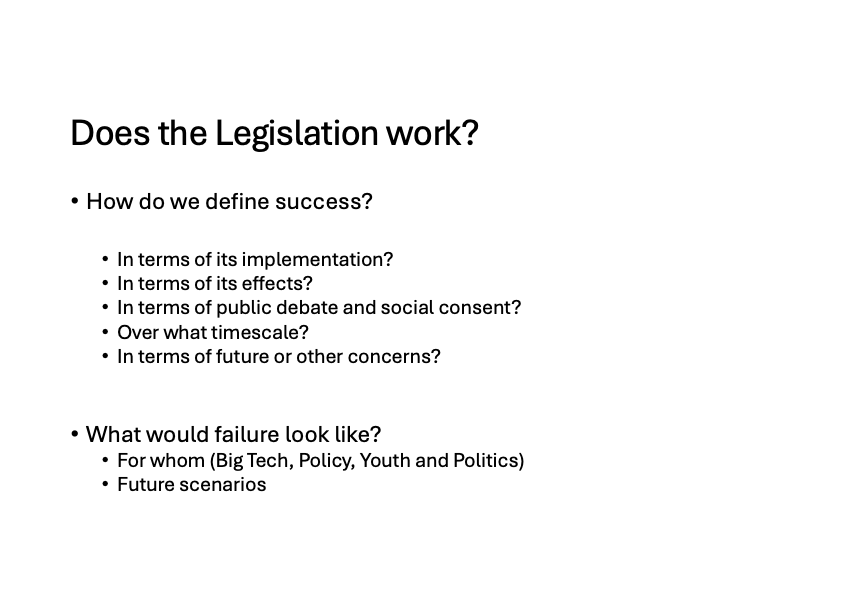
  • What are the likely trajectories for success and how is that defined in these movements?
  • What are the roles of social science, children’s rights advocates and scholars of childhood in these debates?

A deflated account and some of videos from the symposium can be found here

Banning at first sight: fix, regulate, avoid

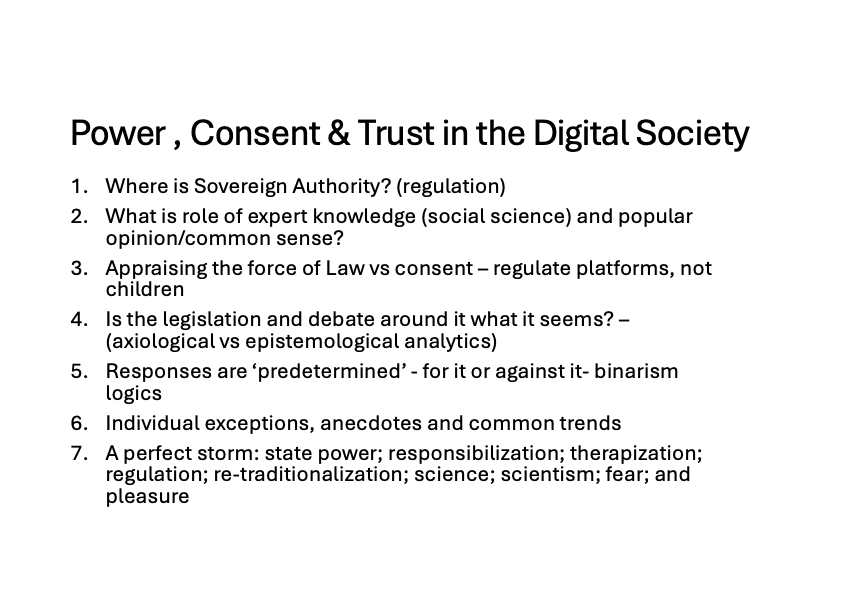
I was recently in Norway, working at the University of Oslo reflecting on some of the success, challenges, difficulties and framing around the social media “ban” in Australia. Norway is currently considering introducing similar kind of legislation and it will be interesting to see how a country with such a strong track record in children’s rights approaches this problem. I reflected on what success and failure of the legislation might mean in its own terms and also in terms of its knock on effects in terms of (perhaps) changing social norms.

I ended up trying to think about the legislation, the motive for it, its’ impact and the criticism it has received along the following seven themes.

While I was there there was intense public interest in the Australian experience. I was interviewed for a newspaper here in a radio show here (broadcast 7th May). The faculty also took advantage of my visit in a student led video raising questions here.

EdTech at the crossroads of pedagogy vs profit

I spoke at this event held by the Digital Futures for Children Centre at the London School of Economics & Political Science. I tried to make the case that the current ‘explosion’ in EdTech needs to be seen in terms of:

  • the platformization of education – privately owned digital platforms now determining, coordinating and defining what happens in schools. Teaching and learning does not just take place between people as a relational or intergenerational exchange but now almost always through or in some ways connected to a platform. The basis for this is the power to reduce all human activity to a measurement whether this is attendance, learning progression, well-being/mental health, assessment, et cetera.
  • the pedagogicisation of everyday life – how school definitions of learning influence other kinds of learning in the home as well as theories about transformations in subjectivity in terms of discipline, values and achievement. Increasing competition for well-paid jobs, decreases in social mobility and the changing role of education as a route to bettering yourself for your family now means that there is an increasing intensity in child rearing and in the home to emphasise forms of educational attainment.

A recording of the event can be found here.

Edutainment 2.0 or eduwashing? The production of educational legitimacy for children’s apps

Ib this article co-authored with colleagues we discuss the phenomenon of what we call ‘edwashing’. On the Apple App Store or Google Play Store, parents can choose from a dazzling number of ‘edutainment apps’ that claim to teach children essential skills whilst also being ‘fun’ and ‘engaging’. In this article, we introduce the phenomenon of ‘eduwashing’ by showing the variety of semantic strategies used by app developers to ‘produce’ educational legitimacy. Taking the popular app Lingokids as a case study, we identify the following three dimensions of eduwashing: edubranding, educlaiming and educertifying. Edubranding involves the use of educational trend words and the appropriation of well-established educational brands. Educlaiming involves the commission of research by developers and the blurring of positivist language with the hyperboles of commercial advertising. Lastly, educertifying involves the use of labels, award and certifications. We conclude by arguing that eduwashing practices make it increasingly difficult for educators and parents to assess the educational relevance of children’s apps.

Creative Expression, Caring Relationships, and Career Pathways: A Guide to Youth Outcomes in Community Arts Programs

Community-based youth arts programs have been shown to provide important, engaging, and empowering experiences for young people. But often, when asked to demonstrate their impact, programs must rely on the anecdotal experiences of participants in their particular program.

I co-led an international collaboration of researchers (from Australia, the United Kingdom, and the United States) who set out to document how young people engage across these programs and what the lasting effects might be for them. The team spoke with alumni of community-based arts programs. We also held workshops with community-based youth arts program leaders to sort through people’s responses and have developed “a taxonomy” of outcomes. This is now available as a report for The Wallace Foundation is available here.

Two main themes emerged from the our interviews: 

  1. Relational outcomes, which shape how arts program participants interact with peers and mentors and come to understand themselves, their community, and their environment. For example, nearly everyone interviewed said their participation in arts programs helped them build enduring friendships and grow as people.
  2. Opportunity outcomes, which are the ways arts programs help young people envision adulthood and pursue careers.  These include the development of workplace skills and exposure to cultural and educational resources that highlight potential careers and other opportunities for young people. 

This taxonomy is aimed at funders and practitioners and we are currently working on a book length output detailing the interviews in greater depth. More soon!

New Book Series – Digital Childhoods

I’m excited to announce that I am leading a team of editors launching a new book series with Palgrave McMillan exploring what we are calling digital childhoods. We aim to bring together interdisciplinary interventions that explore how children and their families experience, utilise and navigate new technologies. Urging scholars to examine the meaning of childhood in the digital age, Digital Childhoods addresses topics relating to how technologies and digital platforms shape families, parenting, and education across formal and informal settings.. 

Thus far, book series about digital transformations, children, youth, the media, education, family life and social change have tended to keep each field of study within conventional academic disciplines. Yet, these kinds of field boundaries are merging as it has become impossible to talk about childhood without considering the digital. Conversely, families and children are now a key arena for debate and discussion in respect of the digital. There is now an intersecting set of academic fields, in both teaching and research contexts, that bring together studies of broad structural and socio-cultural transformations focusing on children and childhoods. The series will bring together, for the first time, scholars who are interested in exploring the effects of digital transformations on family life, the experiences of growing up in a range of different societies, and services and sectors working with children (social work, education). 

The series’ origins lie in the Australian Research Council’s Centre of Excellence for the Digital Child, which brings together scholars from health, education, law, sociology and media and communications to investigate the complex and interdisciplinary nature of digital childhoods. Over the last four years, the Centre has acted as a lightning rod for a range of international scholars from every continent who are exploring the nature of the digital transformation across contemporary childhood and family life. There is both a need for focused publications in this area and a forum to bring together varying disciplinary perspectives on a phenomenon of extraordinary social interest and concern.

The new series particularly welcomes critical publications that address the diverse and contingent nature of contemporary digital childhoods and that challenge normative popular claims about the meanings and implications of digital technologies for children, parenting, and families. This is a timely intervention at a time when much public and policy debate about digital technology and children is predominantly approached through lenses of harm and risk, without in-depth accounts of the complexity and nuance of digital childhoods in differing socioeconomic, geographic, ethnic and cultural contexts. 

The series will feature scholarly works (Pivots from 25,000 to 50,000 words; monographs and edited volumes from 70,000 – 100,000 words) that shifts public vocabularies when discussing this emerging societal issue. Authors and editors are strongly encouraged to write accessibly and to foreground actionable knowledge to inform policymakers, educators, NGOs, NFPs and the media.

We are keen to receive proposals that meet these objectives so please advertise the series and get in touch.

Advising on the social media ban (minimum age obligation)

On December 10th, legislation restricting access to social media for young people under the age of 16 will come into force. The band is incredibly controversial and problematic and the eSafety commission in Australia has commissioned an evaluation led by Stanford University to try to tease out its impact and effect over the next two years. I have been asked to be on the International advisory committee supporting this evaluation. I am looking forward to this challenge and hope to be able to play a part in the public debate surrounding the implementation of the legislation as well as understanding of its impact and effect

Children, media, and the state: envisioning a good childhood in a good society

This invited commentary focuses on the axiological role of “children” and “good childhoods” within public debates about control and regulation of everyday digital cultures. It consider contrasting approaches to direct state control, social norms and big tech in respect of children from China and Australia in order to open up discussions about the role of digital regulation, commercial powers and the changing role of the state.

The commentary aims to stimulate debate around three themes. First, how children and childhoods are often excluded from debates in communication research – a significant theoretical and cultural gap within the wider discipline; secondly, how the Anglo American political economy of Australia shares both similarities and differences with the perceived more authoritarian societies of China thus positioning the Asian Pacific as a key area for focus on the new forms of digital regulation; and thirdly how children and youth themselves provide both proxy and good cause for mechanisms around social control in respect of digital culture.